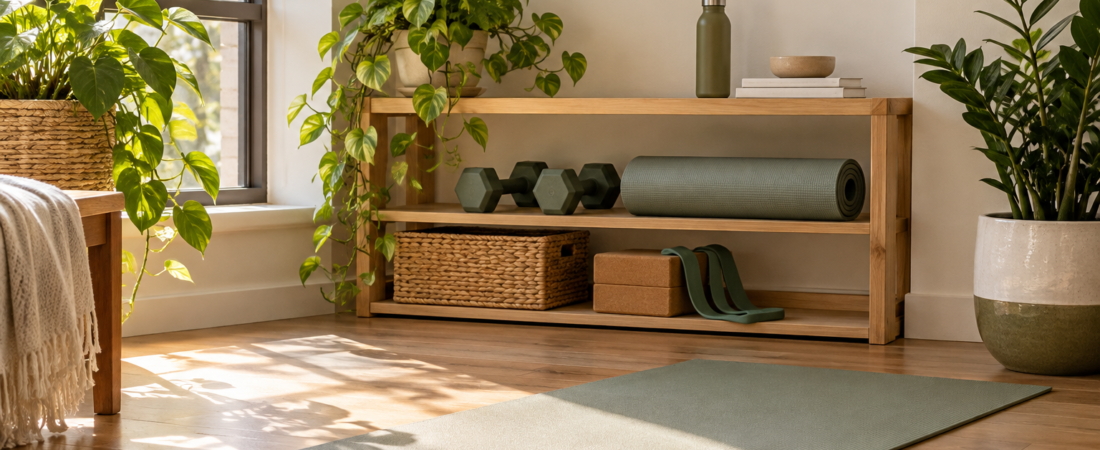
A useful home fitness corner begins with a clear floor and equipment you know how to use. It does not require turning a living room into a gym. The practical challenge is making room for movement, keeping gear accessible, and storing it securely when the room returns to everyday life. Plan those details before adding another bulky item.
Start with the activities you already do
List the activities you expect to use the space for and the equipment each one needs. A mat-based session has different space requirements from a stationary bike. Resistance bands, adjustable dumbbells, and a step platform each need appropriate storage and enough room for their intended use.
This is a guide to arranging space and equipment, not a personalized exercise program. Use activities suitable for your experience and needs, follow equipment instructions, and get qualified guidance when you are unsure how to use an item. Do not buy equipment simply because it looks impressive in someone else’s setup.
Measure the usable floor, including movement
Measure the open floor after moving only the furniture you can realistically move each time. Include the space needed to enter and leave the area. Check doors, low light fittings, shelves, and nearby glass. A mat that fits between the sofa and table does not automatically mean there is enough room for every movement.
Use the equipment manufacturer’s clearance guidance for larger items. Treadmills, bikes, and other machines may need room beyond their physical footprint. Check ceiling height and access routes before ordering. An item that cannot get through the door or be used with appropriate clearance is not a good fit.
Check the surface before choosing a mat
The floor should be level, clear, and suitable for the equipment. Choose protective flooring according to the equipment guidance and your floor type. A soft rug can slide or bunch under some activities, while an unsuitable mat may mark a delicate floor.
Inspect the setup before each use, particularly in a shared room where furniture moves. Keep cables, loose objects, pets, and children out of the activity area. Do not assume a mat makes every movement quiet or protects the structure underneath. If you have concerns about heavy equipment or the floor’s capacity, obtain appropriate advice before placing it there.
Give heavy equipment a stable home
Store weights low on a rack designed for their size and weight. Avoid balancing them on a decorative shelf or stacking them where they can roll. Adjustable equipment needs its own checks: make sure parts are engaged as the manufacturer directs and return loose components to their assigned place.
Choose storage that makes it practical to lift and replace equipment with care. A deep basket may look tidy but become awkward when you have to reach past several heavy items. Do not overload a storage unit, and secure tall furniture according to its instructions.
Keep small accessories together
A shallow container can keep bands, handles, a small towel, and other lightweight accessories together. Store each item as its manufacturer recommends, away from conditions that may damage it. Check bands and attachments for visible wear before use and replace damaged equipment rather than trying to hide a weak point with tape.
Label the container by activity if several people share it. Keep cleaning products separately and away from children. Give the mat somewhere to dry before storing it, following its cleaning and care instructions. Gear that stays damp in a closed cupboard can become unpleasant to use.
Consider noise and neighbors
In an apartment or shared home, think about the people beside and below the space. Choose a location and time that work for the household, and consider equipment noise as well as movement noise. Protective mats may help in some setups, but they do not guarantee sound isolation.
A quiet corner also needs airflow and enough light to see the floor clearly. Keep ventilation openings unobstructed. If you use a fan, position its cable and base safely outside the activity area. Avoid blocking the room’s normal walking route even for a short session.
Test the daily setup before expanding
Run through the practical sequence: move the table, bring out the mat, collect the equipment, and return everything afterward. If this takes too many steps, simplify it. You may need a better storage location rather than more motivation or a larger collection of equipment.
Try the arrangement for a week using the gear you already have. Note anything that repeatedly gets in the way. Keep the pieces you use accessible and reconsider things that never leave storage. A small setup you can maintain is more useful than a crowded corner that is difficult to prepare.
Before each session
- Clear the floor and check the surrounding clearance.
- Inspect equipment and attachments according to their instructions.
- Keep doors, exits, and walking routes usable.
- Keep children and pets away from equipment in use.
- Return heavy items to stable storage after use.
Build the corner around safe access, suitable equipment, and an easy reset. When those basics work, the space can support a consistent home routine without taking over the whole room.